
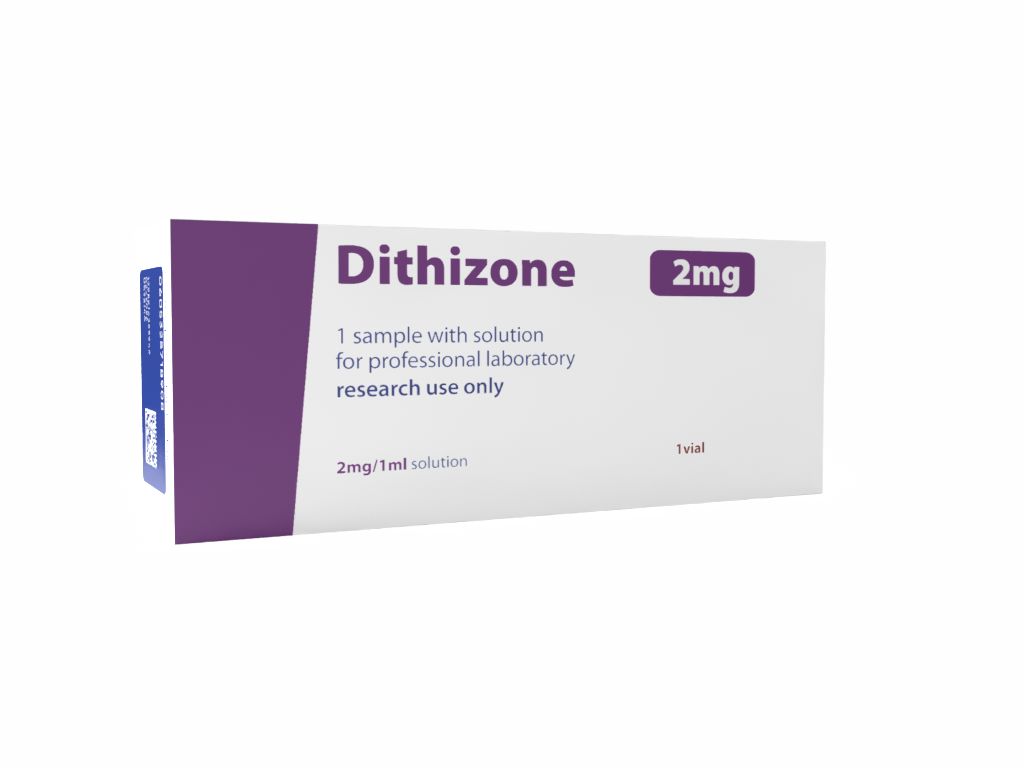
Dithizone 98% 2mg Vial
Delivery time
1-2 working days
quality assurance
Chemical reagent
CAS Number: [60-10-6].
Molecular Formula: C13H12N4S
Price: PLN 499.00
Product temporarily out of stock
Dithizone - Product intended for research purposes
ADDITIONAL INFORMATION:
- The product (substance) is not a food or food supplement and is not suitable for human consumption.
- Keep out of the reach of children.
- Keep the container tightly closed.
- Store in a dry, cool, shaded place; protect from moisture.
- Store only in the original packaging.
- Avoid contact during pregnancy and breastfeeding.
- Consult a doctor if you feel unwell or have adverse reactions related to contact with the substance.
The substance is not a food or dietary supplement and is not suitable for human consumption. The product is classified as a chemical reagent authorised in the European Union and can only be used for scientific research.
Dithizone 2mg- Description and its use
Dithizone Important information:
The sample must first undergo appropriate pretreatment to remove interfering substances and adjust the pH value of the sample. For water quality samples, filtration, dilution or acidification may be necessary; for food samples, digestion, extraction and other steps are required. The sample pre-treatment should ensure that the metal ions exist in the free state and that the pH value of the solution is within the appropriate range for the reaction between the ditizone and the metal ions
Dithizone and Food Zinc Detection:
A preservative, it inhibits the growth of micro-organisms in a cosmetic product. It protects the cosmetic from secondary contamination by micro-organisms that we may introduce during daily use of the product (e.g. by picking up the cream with our finger). It has a very broad spectrum of fungistatic activity and a weaker antimicrobial activity, which is most optimal at pH values up to 6.5.
Dithizone and Lead detection in water quality:
Lead contamination in water poses a serious threat to the environment and human health. Lead is a highly toxic metal that can cause numerous health problems, so precise measurement of its content in water is crucial to ensure its safety. One sensitive and accurate method for detecting lead in water is the dithion colourimetric technique. In solutions with a weakly alkaline pH (8-9), lead ions react with ditizon to form red complexes, which can then be extracted into organic solvents such as carbon tetrachloride or trichloromethane. After extraction, the concentration of lead in water can be determined by spectrophotometry, allowing its content to be calculated accurately.
Determination of mercury content in water using Dithizone
Mercury contamination in water poses a serious environmental and health risk, as mercury is a highly toxic heavy metal. Consequently, the precise determination of its content in water is crucial for the protection of human health. One of the methods used to detect mercury in water is the ditizon colourimetric technique. In an acidic environment (0.5 Mol/L sulphuric acid), mercury ions quickly form complexes with ditizon, which have an orange colour. These chelates are soluble in organic solvents such as chloroform or carbon tetrachloride. After extraction, the mercury content in water can be accurately determined using spectrophotometry.
Detection of cadmium content in water quality
Cadmium is a toxic heavy metal that poses a serious threat to human health. To accurately determine its content in water, a colorimetric method using ditizon can be used. Under strongly alkaline conditions, cadmium ions react with ditizon to form a red complex. After extraction of this chelate with chloroform, the cadmium content in water can be accurately determined by colourimetric analysis.
Dithizone Safety
The basic principle of this method is based on a chemical reaction between metal ions and a dithionic reagent under defined conditions. These reactions produce chelates with characteristic colours, the intensity and stability of which depend on the type of metal, the pH of the solution and the reaction conditions. With the right choice of pH and reaction conditions, metal ions can react with ditizon to form chelates that are easy to isolate and detect.
During the reaction, the metal ions form coordination bonds with the sulphur and nitrogen atoms of the ditizone molecule, leading to the formation of stable chelates. These chelates, which have a distinct colour, can be enriched and purified by extraction into organic solvents. The extracted chelate solution is analysed by spectrophotometry. By comparing the absorbance of the sample with a standard solution, the concentration of metal ions in the sample can be accurately determined.
Dithizone - Product intended for research purposes.
14 day return policy
LAboratory quality
Safe shopping
Opinions
 Novell – peptide reagents
-
 Ada O.